

People flow with computer vision
Computer vision turns video into movement metrics: counts, occupancy, trajectories, queues, dwell time and heat maps. This makes it clear how each space is used, so decisions about capacity, staffing and experience are backed by data.
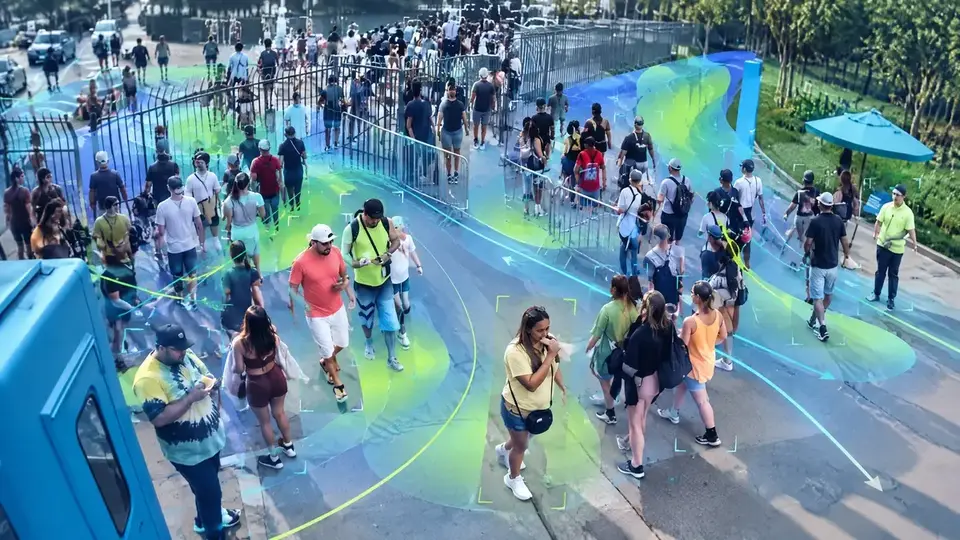
What can be measured
- Entries and exits by area.
- Occupancy of rooms and zones.
- Trajectories and movement patterns.
- Queues and dwell time.
- Heat maps and concentration.
- Bottlenecks at passage points.
From camera to metric
Footage is processed to detect and track people across the scene. Events become metrics by hour, day and zone, feeding dashboards, reports, APIs or operational systems.
Where it applies
- Airports and terminals.
- Hospitals and service areas.
- Commercial buildings and public spaces.
- Retail, events and urban facilities.
- Any operation that needs to understand queues, occupancy and visitor journeys.
Privacy by design
A people flow project starts from its purpose and from data minimization. In most cases the value lies in counts and aggregated trajectories, not in who the person is. Access, retention and processing follow Brazil’s General Data Protection Law (LGPD) and the client’s policies.
Read next: how camera-based people counting works.
Assessment of your cameras
The first step is to look at the cameras you already have and tell you what they can do. Then a proof of concept with your own footage shows the result in the field. Depending on the size of the project, both steps can be free of charge, and the proof of concept starts running within 10 days of the agreement between the parties.
Assessment
We review image quality, position, lighting and network of the existing cameras against what you want to detect.
Proof of applicability
We run the analysis on real scenes from your site and measure it against the agreed success criteria.
Deployment
On-premises, central, cloud or hybrid, with rules, alerts, user roles and integrations configured.
Continuous calibration
Rules and models are tuned per camera using the real event history.
Frequently asked questions
How does camera-based people counting work?
Computer vision detects and tracks each person in the scene and counts them when they cross a line or enter a zone. The result is entries, exits, occupancy and flow per period.
Is facial recognition required?
No. Counting, occupancy, tracking and trajectories work without facial recognition when the purpose does not require identifying anyone.
Can existing cameras be used?
Yes, when angle, resolution, coverage and lighting are suitable for the desired metric. High-mounted cameras with a top-down view usually count better.
What affects counting accuracy?
Camera height and angle, resolution, field of view, people blocking each other, lighting and the correct definition of counting lines and zones.
Is camera-based people counting compatible with Brazil’s data protection law (LGPD)?
Yes, when the purpose is defined and the data is aggregated. Counting does not need to identify anyone; access to the images and the retention period follow the client’s policies.
Can the capacity of a room be controlled?
Yes. With entries and exits counted, the system shows occupancy in real time and alerts when the defined capacity is reached.
What do you want your cameras to tell you?
Tell us what you need to detect, measure or monitor. We start with the problem, not the technology, and the assessment uses images from the cameras you already have.
- Phone and WhatsApp
- +55 11 3636-8989
- Address
- Al. Terracota, 185, conj. 1213 — São Caetano do Sul, SP, 09531-190