

Computer vision for hospitals
Hospitals have complex flows of patients, visitors, staff and supplies. Computer vision supports operations with metrics on occupancy, circulation, dwell time and access, always taking privacy, purpose and governance into account from the design stage.
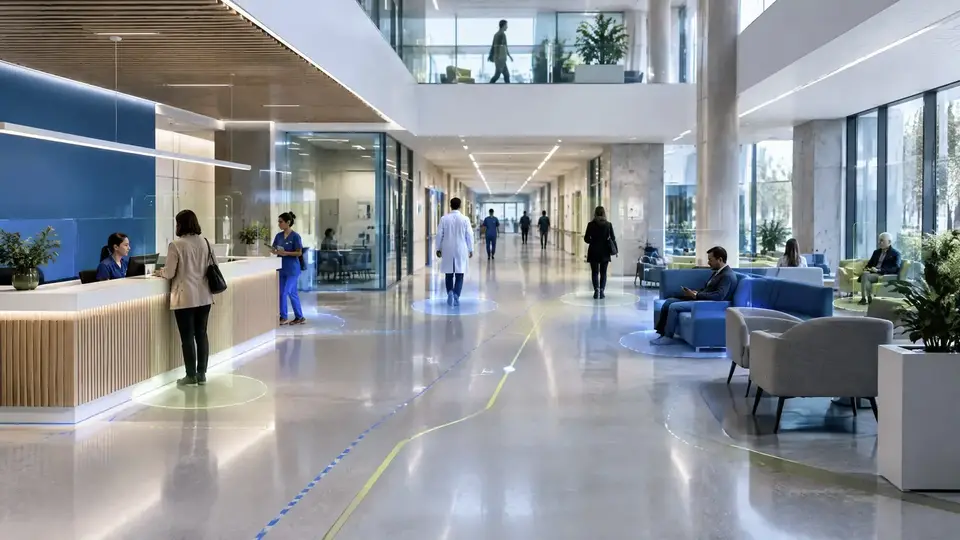
Possible applications
- Occupancy of waiting areas.
- Counting and flow between rooms.
- Dwell time in configured areas.
- Queues and concentration at service points.
- Access to operational areas.
Privacy is an architecture requirement
In healthcare, responsible use of images is essential. The solution collects and stores only what is necessary for the defined purpose, with access control and policies suited to the environment.
Operational integration
Metrics can be sent to dashboards, APIs or management systems to support decisions on capacity, flow and staff scheduling.
Questions management starts to answer
- How many people are waiting right now at the emergency reception?
- On which days and at what times does the wait exceed the limit?
- Which accesses to restricted areas happened outside permitted hours?
- How does the occupancy of each area change throughout the day?
Occupancy by day and hour
Metrics can be organized into an occupancy map by day of the week and hour, showing the peaks of each area and helping to size reception, triage and staffing.
Assessment of your cameras
The first step is to look at the cameras you already have and tell you what they can do. Then a proof of concept with your own footage shows the result in the field. Depending on the size of the project, both steps can be free of charge, and the proof of concept starts running within 10 days of the agreement between the parties.
Assessment
We review image quality, position, lighting and network of the existing cameras against what you want to detect.
Proof of applicability
We run the analysis on real scenes from your site and measure it against the agreed success criteria.
Deployment
On-premises, central, cloud or hybrid, with rules, alerts, user roles and integrations configured.
Continuous calibration
Rules and models are tuned per camera using the real event history.
Frequently asked questions
Does computer vision in hospitals identify patients?
It does not need to. Occupancy, queue and flow metrics work with aggregated data, without identifying patients, in line with Brazil’s General Data Protection Law (LGPD).
Is people counting in a hospital compatible with the LGPD?
Yes, when the purpose is defined and the data is aggregated: the system counts and measures dwell time without identifying patients, and access to the images is restricted to authorized roles.
Can the waiting time at reception be measured?
Yes. AI counts how many people are in the waiting area and how long they stay, and alerts when the wait exceeds the defined limit.
What do you want your cameras to tell you?
Tell us what you need to detect, measure or monitor. We start with the problem, not the technology, and the assessment uses images from the cameras you already have.
- Phone and WhatsApp
- +55 11 3636-8989
- Address
- Al. Terracota, 185, conj. 1213 — São Caetano do Sul, SP, 09531-190