

Computer vision for mining and industry
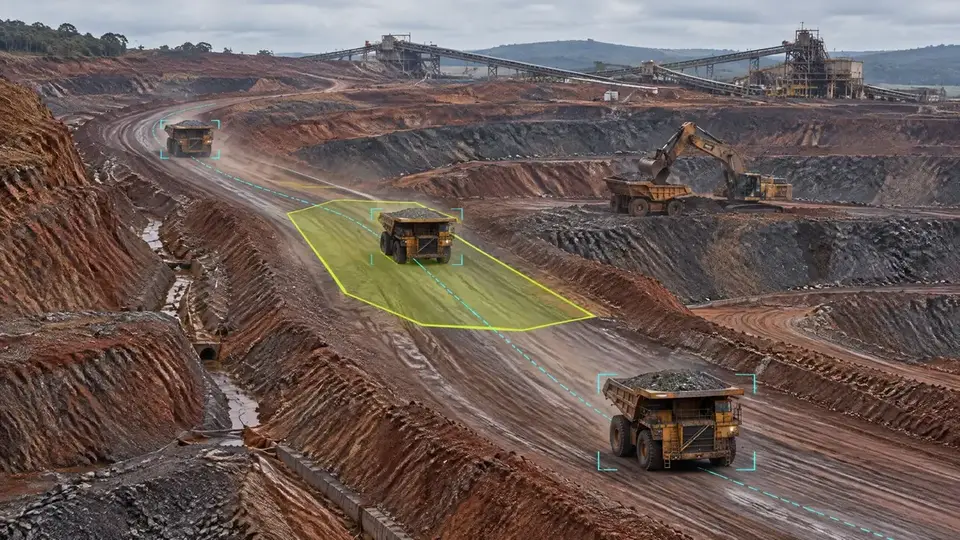
Mining and industrial operations run in large, dynamic environments with hazard zones. Computer vision helps monitor people, vehicles, machinery and movements, using cameras as additional sensors for the operation.
Possible applications
- Monitoring of areas and hazard zones.
- Detection and classification of vehicles and machinery.
- Presence of people in defined areas.
- Tracking of movements and cycles.
- Events for specific places and times.
The challenge is the real environment
Dust, lighting, distance, vibration, weather and obstructions affect the image. That is why each application is assessed with real data from the site and success criteria defined before scaling up.
Edge AI for distributed operations
Where connectivity is limited or low latency is required, the analysis runs close to the cameras and sends only consolidated events to central systems.
Perimeter in large and critical areas
In mines and industrial plants, cameras cover fences, access points and restricted-access areas, such as the surroundings of dams, stockpiles and storage yards. AI alerts when a person or vehicle enters the zone at a time or under conditions that are not permitted, with the image for the team to confirm.
People near machines
Zones around moving equipment can be configured to alert when a person is inside. It is an additional layer of attention for the team and does not replace the machines’ own safety systems.
Assessment of your cameras
The first step is to look at the cameras you already have and tell you what they can do. Then a proof of concept with your own footage shows the result in the field. Depending on the size of the project, both steps can be free of charge, and the proof of concept starts running within 10 days of the agreement between the parties.
Assessment
We review image quality, position, lighting and network of the existing cameras against what you want to detect.
Proof of applicability
We run the analysis on real scenes from your site and measure it against the agreed success criteria.
Deployment
On-premises, central, cloud or hybrid, with rules, alerts, user roles and integrations configured.
Continuous calibration
Rules and models are tuned per camera using the real event history.
Frequently asked questions
Does computer vision work in mines without internet?
Yes. With on-site (edge) processing, the analysis happens close to the cameras and events are sent whenever a connection is available.
Can AI monitor the surroundings of dams?
It can monitor access points and areas defined by cameras, alerting on the presence of people and vehicles. It does not replace geotechnical instrumentation or the dam’s safety plans.
Do dust and rain get in the way?
They can reduce image quality. That is why the assessment uses real footage from the site, at different times and conditions, before defining what is feasible.
What do you want your cameras to tell you?
Tell us what you need to detect, measure or monitor. We start with the problem, not the technology, and the assessment uses images from the cameras you already have.
- Phone and WhatsApp
- +55 11 3636-8989
- Address
- Al. Terracota, 185, conj. 1213 — São Caetano do Sul, SP, 09531-190