

Technology
Computer vision in production takes more than a model that works in a demo. The solution has to handle different cameras, changing light, obstructions, distance, unstable networks, integration and continuous operation, day and night.
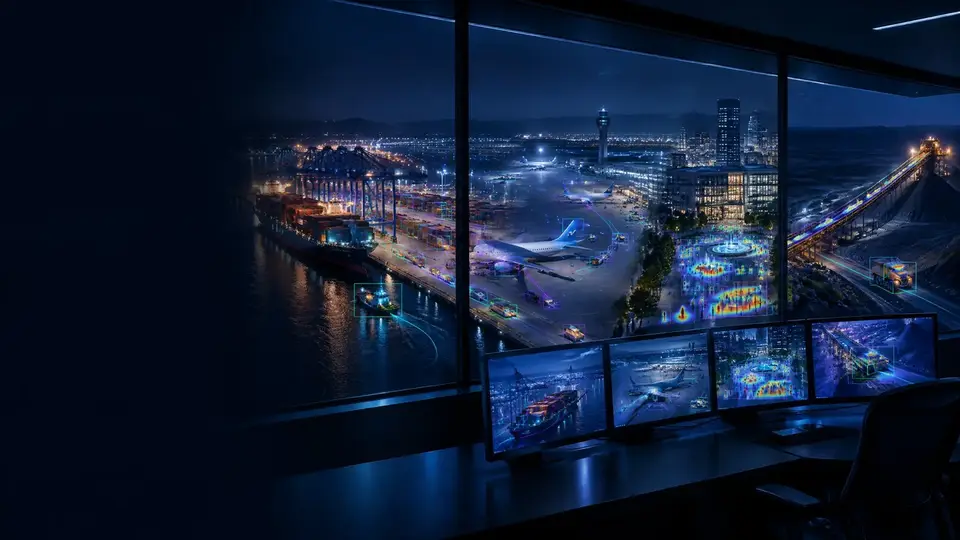
Architecture driven by the scenario
Analysis can run at the edge, on central infrastructure, in the cloud or in a hybrid model.
| Layer | Role |
|---|---|
| Cameras and VMS | Provide images and video streams (IP, RTSP, ONVIF). |
| Analysis | Models detect, classify and track objects and evaluate rules. |
| Events | Results become data, alerts, evidence and metrics. |
| Integration | APIs, VMS, messaging, dashboards and monitoring centers receive the generated context. |
Works with what you already have
Omnicog is an intelligence layer on top of your existing infrastructure: no need to replace your VMS or monitoring center.
IP cameras, DVRs and NVRs
Video over RTSP or ONVIF, standard in most brands.
VMS and monitoring centers
Integration with Digifort and Kria; events with images sent to the monitoring center or the control room.
API and webhooks
Events and indicators for business systems, dashboards and BI.
Mobile and email
Alerts in the app and scheduled PDF reports.
Edge AI
Processing close to the cameras reduces latency, saves bandwidth and keeps the analysis running when the connection fails. At highway toll plazas, for example, the local unit keeps operating without the central system.
Computer vision models
Detection, classification, tracking, zones, counting, dwell time, trajectories, license plate recognition and time-based rules. We use GPU acceleration (NVIDIA) to analyze dozens of cameras per server.
Integration from day one
An isolated detection rarely creates value. The event has to reach the person or system that can act on it, so integration is part of the solution from the very first design.
Privacy, security and governance
Purpose, access, retention and data minimization are part of the design, in line with Brazil’s General Data Protection Law (LGPD) and the client’s policies.
How we validate
Real scenes
We select representative scenes from the real environment.
Criteria
We define classes, events and success criteria.
Pilot
We run the pilot and measure the results in the field.
Tuning
We adjust models, rules, cameras or architecture.
Scale
We integrate and scale once the application proves its value.
Frequently asked questions
Where does Omnicog’s video analysis run?
Close to the cameras (edge), on central servers, in the cloud or in a hybrid model. The choice depends on latency, number of cameras, network, security, cost and integration.
Which computer vision techniques does Omnicog use?
Detection, classification, tracking, zone and line analysis, counting, dwell time, trajectories, license plate recognition and time-based rules, combined according to what the operation needs to see.
How does Omnicog validate an application?
With real scenes from the environment, classes and success criteria defined in advance, a pilot measured in the field, and adjustments to the model, rule, camera or architecture before scaling up.
Want to discuss architecture, cameras or integration?
Talk to Omnicog’s technical team.
- Phone and WhatsApp
- +55 11 3636-8989
- Address
- Al. Terracota, 185, conj. 1213 — São Caetano do Sul, SP, 09531-190