

Computer vision for ports and logistics
Ports and terminals bring together people, trucks, equipment, cargo and controlled-access areas. Computer vision increases operational awareness by turning cameras into a continuous source of events and data.
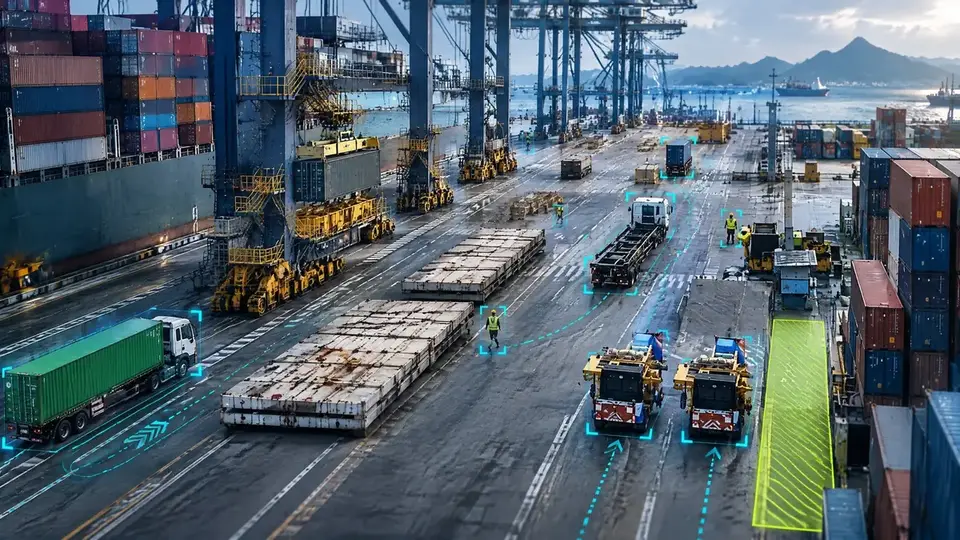
What can be detected
- People, vehicles and equipment on berths, yards and access roads.
- Presence in restricted areas or hazard zones.
- Movement at gates and passage points.
- Occupancy of yards and waiting areas.
- Specific events defined for the operation.
Experience in port environments
Omnicog has already applied detection of classes such as people, vehicles and equipment in port areas. Each project depends on the available footage, the objective and the integrations required.
From detection to the control center
Value appears when the event does not stop at the AI model: it has to reach the team, system or process that can act on it. That is why integration with the terminal’s ecosystem is part of the solution design.
Port security and access control
Terminals follow security plans with access control, restricted areas and continuous surveillance, such as those set out in the ISPS Code. Computer vision supports these routines: it alerts on a person or vehicle in a restricted area, logs passages at gates with images and cuts the time the team spends watching screens with no events.
Compliance remains the terminal’s responsibility; the technology provides alerts and evidence.
Metrics for the operation
- Truck dwell time at gates and waiting areas.
- Yard occupancy and access queues.
- People in hazard zones near moving equipment.
- Vehicle passages with license plate reading.
Assessment of your cameras
The first step is to look at the cameras you already have and tell you what they can do. Then a proof of concept with your own footage shows the result in the field. Depending on the size of the project, both steps can be free of charge, and the proof of concept starts running within 10 days of the agreement between the parties.
Assessment
We review image quality, position, lighting and network of the existing cameras against what you want to detect.
Proof of applicability
We run the analysis on real scenes from your site and measure it against the agreed success criteria.
Deployment
On-premises, central, cloud or hybrid, with rules, alerts, user roles and integrations configured.
Continuous calibration
Rules and models are tuned per camera using the real event history.
Frequently asked questions
Does computer vision help meet the ISPS Code?
It supports routines that the terminal’s security plan requires, such as surveillance of restricted areas and logging of access, with alerts and images. Compliance remains the terminal’s responsibility.
Can truck time at the gate be measured?
Yes, when the cameras cover the entrance and exit of the area. AI detects the vehicle, or reads the plate, and calculates the dwell time in each zone.
Which classes can be recognized in a port?
People, vehicles and equipment are the most common examples. Other classes can be assessed depending on the scenario and image quality.
Does it work in large outdoor areas?
It can, but distance, resolution, angle, lighting and weather must be assessed point by point.
What do you want your cameras to tell you?
Tell us what you need to detect, measure or monitor. We start with the problem, not the technology, and the assessment uses images from the cameras you already have.
- Phone and WhatsApp
- +55 11 3636-8989
- Address
- Al. Terracota, 185, conj. 1213 — São Caetano do Sul, SP, 09531-190